Back-to-School Separation Anxiety in Dogs: A Utah Trainer's 10-Day Plan
By Bart Merrell ·
Every August, the house empties out and dogs fall apart. Here's how to tell real separation anxiety from plain boredom, what actually fixes it, and the honest reason we don't correct a panicking dog.
Every August my phone does the same thing.
The calls start about a week after the kids go back, and they all sound alike. He's never done this before. Chewed the door frame. Screamed for four hours straight - the neighbor finally texted. Peed on the bed, and he's been house-trained since he was five months old.
Then, almost every time, the same guess: “I think he's mad at us.”
He isn't. Dogs don't do spite. What actually happened is that your dog spent ten weeks with a full house - kids home, snacks on the floor, somebody always available - and then on a Wednesday morning in August, all of it vanished at once. Granite starts August 12 this year. Salt Lake City, Jordan, Nebo, Alpine, Provo, Park City and Davis all fall between the 18th and the 20th. From your dog's side of it, the world just emptied out with no warning and no explanation.
The good news is that if you're reading this before the first day, you have time to make this a whole lot easier. And if you're already living it, you're not stuck.
Why does back-to-school season set dogs off?
Dogs run on patterns. Not clocks - patterns. Your dog doesn't know it's 8:15, but he knows that the shower runs, then the coffee grinder, then somebody's on the stairs, and eventually people settle in the front room and he settles with them.
All summer, that pattern said company. Kids sleeping in, the back door opening every twenty minutes, three different people wandering through the kitchen. Your dog built his whole day around it, including his naps.
Then the pattern breaks in a single morning. Same house, same smells, nobody in it. For a lot of dogs that's just weird and boring. For some, it's genuinely frightening - especially dogs who never really learned that being alone is survivable.
That last part matters more than most people realize. A dog who has almost never been by himself hasn't decided he hates it. He simply has no evidence yet that you come back. Alone-time is a skill, and like every other skill, dogs are bad at it until somebody teaches it.
Is it separation anxiety, or is my dog just bored?
These look identical from the driveway and they need completely different plans, so it's worth sorting out before you spend a month working on the wrong problem.
The easiest test is free: point your phone at the room, prop it up, and leave. Watch the first thirty minutes.
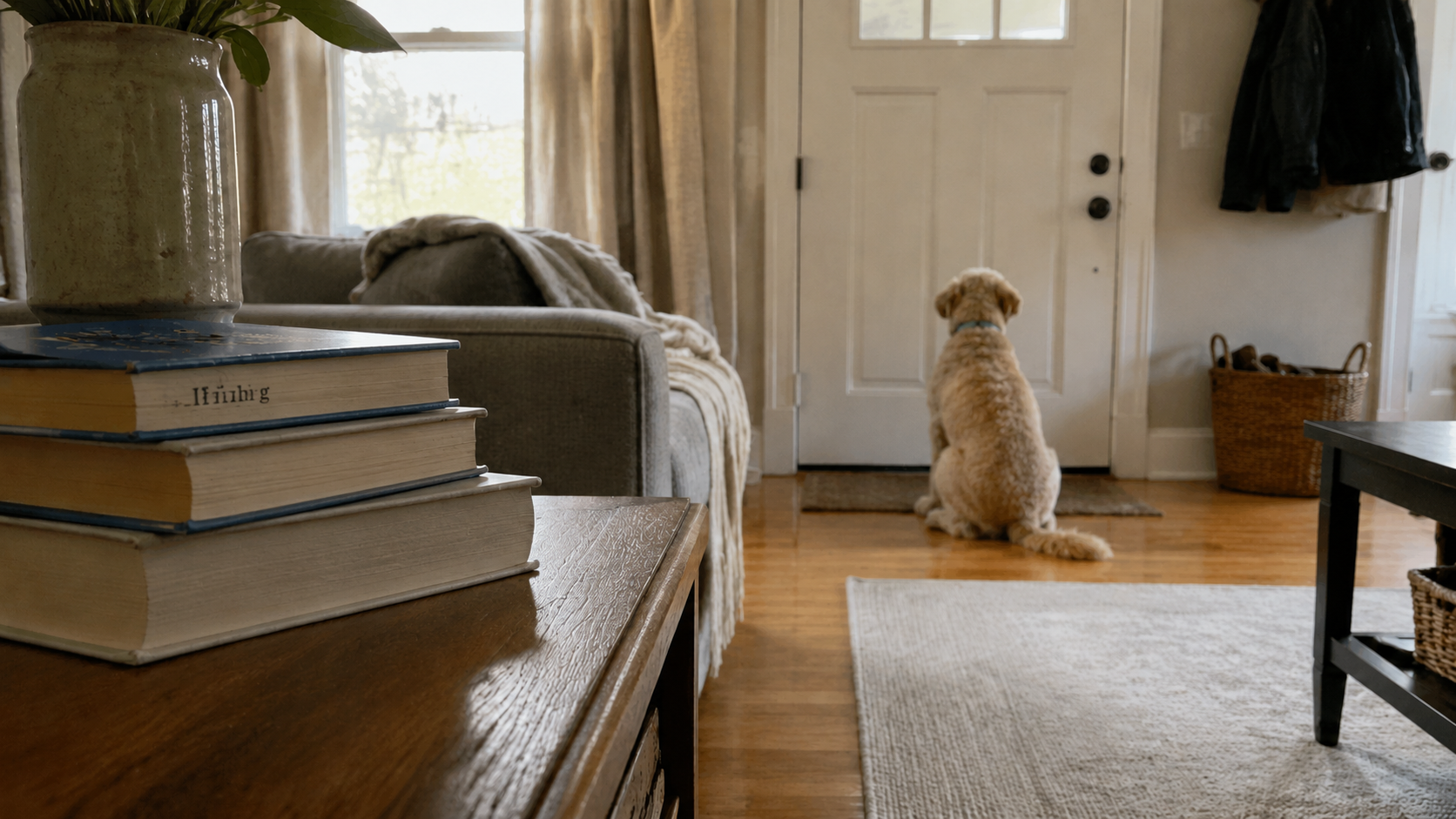
A dog in genuine distress unravels fast. Panting, pacing the same loop, whining or howling that starts within the first few minutes, drooling, scratching at the door or the window you left through. Damage is usually at the exits - door frames, blinds, the crate door - because he's trying to follow you, not redecorate. Accidents from a house-trained dog point this direction too. If your dog is coming apart inside the first 15 to 20 minutes, that's a panic response.
A bored dog is fine, then gets ideas. He watches you go, sighs, sleeps for an hour and a half, wakes up with nothing to do, and finds the trash. The damage is scattered and opportunistic - a shoe from the closet, the couch cushion, whatever was reachable. The timeline is the tell: distress starts immediately, boredom starts later.
A third one nobody talks about: the dog who's just wildly under-exercised. Ten weeks of summer with kids meant nonstop low-grade activity. Now he gets one leash walk and eight hours of nothing, and all that unspent energy has to go somewhere - and if he's also dragging you down the sidewalk on that one walk, the walk isn't doing what you think it's doing.
Plenty of dogs are some blend of all three. But if what you're seeing is panic, keep reading closely, because the next section is the part most owners get backwards.
The 10-day plan: start before the first day of school
If school hasn't started for your family yet, this is the highest-value stretch of the whole year. You're not asking your dog to adjust - you're spending the change slowly so he barely notices.
- Move the schedule now, in fifteen-minute pieces. If he's been eating at 9:30 and getting up at 8, walk both back toward the school-year time over the next week and a half. Fifteen minutes every day or two. Dogs handle drift much better than cliffs.
- Practice leaving, on purpose, every single day. This is the actual work. Get your keys, put your shoes on, walk out, close the door - and come back in ten minutes. Go get a Coke. Sit in the driveway. It doesn't matter where you go; the point is that he watches you leave and then watches you come back, over and over, until the departure stops meaning anything. Build from ten minutes toward an hour across the week. If he panics at ten, drop to two and build from there. Practicing only real absences teaches him that the door closing means six hours of being alone.
- Break your own departure ritual. Most dogs start climbing the walls before you're even out the door, because the sequence is so predictable: keys, purse, shoes, door. So take that sequence apart. Pick up the keys and then sit down and watch TV. Put your shoes on and go do the dishes. Grab the purse and set it back down. When the cues stop predicting anything, they stop generating dread.
- Give him one specific place. A crate he already likes, or a gated room - one spot that's his, every time, whether you're home or not. Feed him in there. Give him the good chew in there. Let him nap in there while the house is full and busy. A safe space he only ever sees on his worst days isn't a safe space; it's a warning sign. Build the habit now so that by the 18th it already means nothing bad happens here.
- Front-load the exercise, in the morning, before you go. A tired dog sleeps through his own worry. But this is August in Utah - a 2 p.m. walk is a bad idea for reasons that have nothing to do with anxiety. Go early, while it's still cool, and let it be a real outing: Dimple Dell, the Jordan River Parkway, Millcreek, the Provo River Trail. Sniffing tires a dog out far more than distance does.
- Hand the departure to the kids. This one's easy and it works. The last thing that happens before the kids walk out the door is that one of them gives the dog a stuffed Kong or a frozen puzzle toy - and it's the only time he gets it. Xylitol-free peanut butter, plain yogurt, wet food, whatever he likes. Within a week the backpacks going on the shoulders starts to predict something good instead of something bad.
- Feed a real breakfast, and make him work for part of it. Scatter a handful in the yard. Use a snuffle mat or a food puzzle. Chewing and foraging both settle a dog's nervous system in a way that another lap around the block doesn't.
- Stop the dramatic goodbyes. I know. But the two-minute farewell with the face-holding and the mommy will be back soon teaches your dog that departures are a big emotional event. Leave like you're going to the mailbox. Come home and ignore him for five minutes until he's settled, then say hello. Calm coming and going, calm dog.
- Add sound. Leave a radio, a TV, or a fan running. Steady background noise covers the neighborhood sounds that pull a dog to the window - the mail truck, a car door, kids on the sidewalk - and gives the house a less-empty feel.
- Do a full dress rehearsal. A few days before school starts, run the whole morning exactly as it'll happen. Real wake-up time, real breakfast, real walk, everybody out the door on schedule. Come back after two hours. You'll learn more from one rehearsal than from a week of theorizing, and if something falls apart, you find out while there's still time to fix it.
Where we draw the line, and why
We're balanced trainers. We use corrections, we're upfront about it, and we've written at length about what balanced training actually means and where it belongs.
Here's the part that surprises people: we don't correct a dog for panicking, and neither should you.
A correction is information. It tells a dog that choice doesn't work, try another one. That's fair and useful when a dog is making a choice - blowing off a recall he knows, jumping the fence line, dragging you down the sidewalk. It's exactly the wrong tool for fear, because a frightened dog isn't choosing anything. There's no better option for him to switch to. All a correction adds is one more scary thing happening while he's already scared, and the reliable result is a dog who is quieter about being terrified.
So if your dog is genuinely coming apart when you leave, you're not going to punish your way out of it. You're going to build the skill he's missing, in pieces small enough that he never has to panic in the first place. That's the plan above, and it's slower than anybody wants it to be - which is the same honest answer we give about how long training actually takes.
And to be clear about the flip side: the crate is not the villain here. A dog who's been taught to love his crate is a dog with somewhere safe to go. A dog who gets shoved in one for the first time on the first day of school is a dog in a box, panicking. Same object, completely different experience, and the difference is entirely in the preparation.
What makes it worse
- Punishing the mess when you get home. He can't connect the puddle to the panic four hours ago. All he learns is that you come home angry, which makes your leaving worse.
- Going cold turkey. Zero alone time all summer, then seven hours on Wednesday. This is the single most common way a manageable adjustment becomes a real behavior problem.
- Getting a second dog to fix it. Sometimes this helps. Often you now have two dogs with a problem, plus a second dog. Don't make it your first move.
- Doubling the exercise and calling it done. Exercise is a legitimate piece of the plan and it will not, by itself, teach a dog that being alone is safe.
- Waiting to see if it passes. True separation distress usually deepens with practice. Every day he spends panicking is a day he rehearses panicking.
- Assuming it's spite. It shapes everything you do next, and it's wrong.
When to loop in your vet
Call your vet if the behavior is severe - if he's hurting himself trying to get out, breaking teeth or nails on the crate, refusing food all day, or if this came on suddenly in a dog who used to be fine on his own. Sudden changes in a previously settled adult dog sometimes have a medical piece underneath, and it's worth ruling that out before you commit to months of behavior work.
For dogs who are too far gone to learn anything while you're out the door, anti-anxiety medication is a genuinely reasonable option, and it isn't a failure or an admission that you did something wrong. It lowers the volume enough that the training can actually land. Plenty of dogs use it for a stretch and come off it later. That's a conversation for your vet, not for us - but we'll never talk you out of having it.
When to call us
Most families handle this themselves with the plan above. Some don't, and there's no prize for white-knuckling it.
Reach out if you've worked the plan for two or three weeks with nothing to show for it, if your dog is hurting himself, if you're getting complaints from neighbors or a landlord, or honestly if you've just hit the end of your rope. That last one counts. Dogs get given up on over exactly this kind of thing - behavior problems are one of the biggest reasons dogs end up surrendered in this country, and a huge share of those are ordinary problems that nobody got help with in time.
How we'd approach it:
- 1-on-1 training is usually the right call for separation issues. This work happens in your house, on your doorway, with your schedule - that's the whole point, and it's hard to outsource. We coach you through the departure work and the settling, and we adjust as your dog tells us what he needs.
- Board & train makes sense when there's a bigger picture - a dog who's also reactive, or pulling you down the street, or has no foundation at all. Your dog lives in our home in Murray, works multiple times a day, and comes back with the obedience and the off-switch that make everything else easier. We keep it to four dogs at a time, and we've laid out exactly what happens in there.
- Puppy School if you've got a young one under six months. Teaching alone-time now, before it's a crisis, is about a tenth of the work.
We serve Salt Lake, Utah, Summit and Weber counties - Ogden down to Provo, Park City over to Sandy. The evaluation is free and it's not a sales pitch; if you don't need us, we'll tell you so and point you at the right next step.
Call or text (801) 592-1524, or book a free evaluation. We're around 8 a.m. to 10 p.m., seven days a week.
Your dog doesn't need the house full all day. He needs to learn that when the door closes, it opens again. That's a teachable thing, and August is the right time to teach it.
- Bart
Frequently asked questions
Keep reading
Written by Bart Merrell, certified dog trainer at Top Dog Dog Training.