Halloween Is the Single Best Training Night of the Year
By Bart Merrell ·
Every dog article this week says hide your dog in a back bedroom. For a lot of dogs, that throws away the most valuable training night of the year. Here's the math, and the exact door drill to run.
Every dog article you'll read this week says the same thing: put your dog in a back bedroom, turn on the TV, and ride it out.
For some dogs, that's exactly right, and I'll tell you how to know if yours is one of them.
But for a lot of you, that advice is throwing away the most valuable training night you'll get all year, and I mean that literally. Here's the math.
On Saturday night, your doorbell is going to ring somewhere between thirty and eighty times in about three hours. Halloween falls on a Saturday this year, so expect the heavy end of that. Each ring comes with a natural pause afterward, a built-in reset while the next group walks up the street. Real people at the door. Real excitement. Real arousal.
You cannot buy that. I can't manufacture it for you in a session. Normally your doorbell rings maybe three times a week, you're not ready, your hands are full, and the delivery guy is gone before you've found the treat bag. On Halloween, you get a hundred reps of the exact scenario that's been beating you, and you get to be ready for every single one.
What you do with those reps is the whole post.
What you're actually building
That's it. Not “stop barking.” Not “calm down.” One clear thing to do, in a specific place, with a paycheck attached.
And this is the part worth understanding, because it's why the night works. You are not just teaching obedience. You're changing what the doorbell means.
Right now, that sound predicts something exciting and uncertain, and your dog's response, the barking, the charging, the spinning at the door, is the only answer he's got. By the end of Saturday night, that sound is going to predict a bed and a piece of chicken. Dogs are relentless pattern-finders. Give them forty repetitions of the same pattern in one evening, with a payout every time, and they will find it.
That's why this holds. You're not drilling a command into him. You're giving him a new, better answer to a question he's been getting wrong.
First: is this your dog's night?
This is a training opportunity for a dog who's excitable and noisy at the door. It is not a training opportunity for a dog who's frightened or aggressive at the door, and trying to make it one will cost you ground. If you're not sure which one you have, read reactive dog vs. aggressive dog: what's the difference before Saturday.
Skip the drill and set your dog up somewhere quiet if any of this is true:
- He has ever growled, snapped, or lunged at someone coming in
- He's genuinely fearful of strangers: tucking, retreating, barking from behind you
- He won't take food when he's worked up (that's the clearest signal you'll get that he's over his limit)
- He's a bolter and you don't have a second adult to work the door
For those dogs, Saturday is a management night. Back room, frozen Kong, white noise, done. You're not failing. You're just not running a training session on the worst possible evening for it. Call me in November and we'll build it properly, with the door opening to one calm adult instead of a shrieking Spider-Man.
For everybody else, the dog who loses his mind but means well, keep reading.
Set up before dark
Thirty minutes of prep decides whether this works.
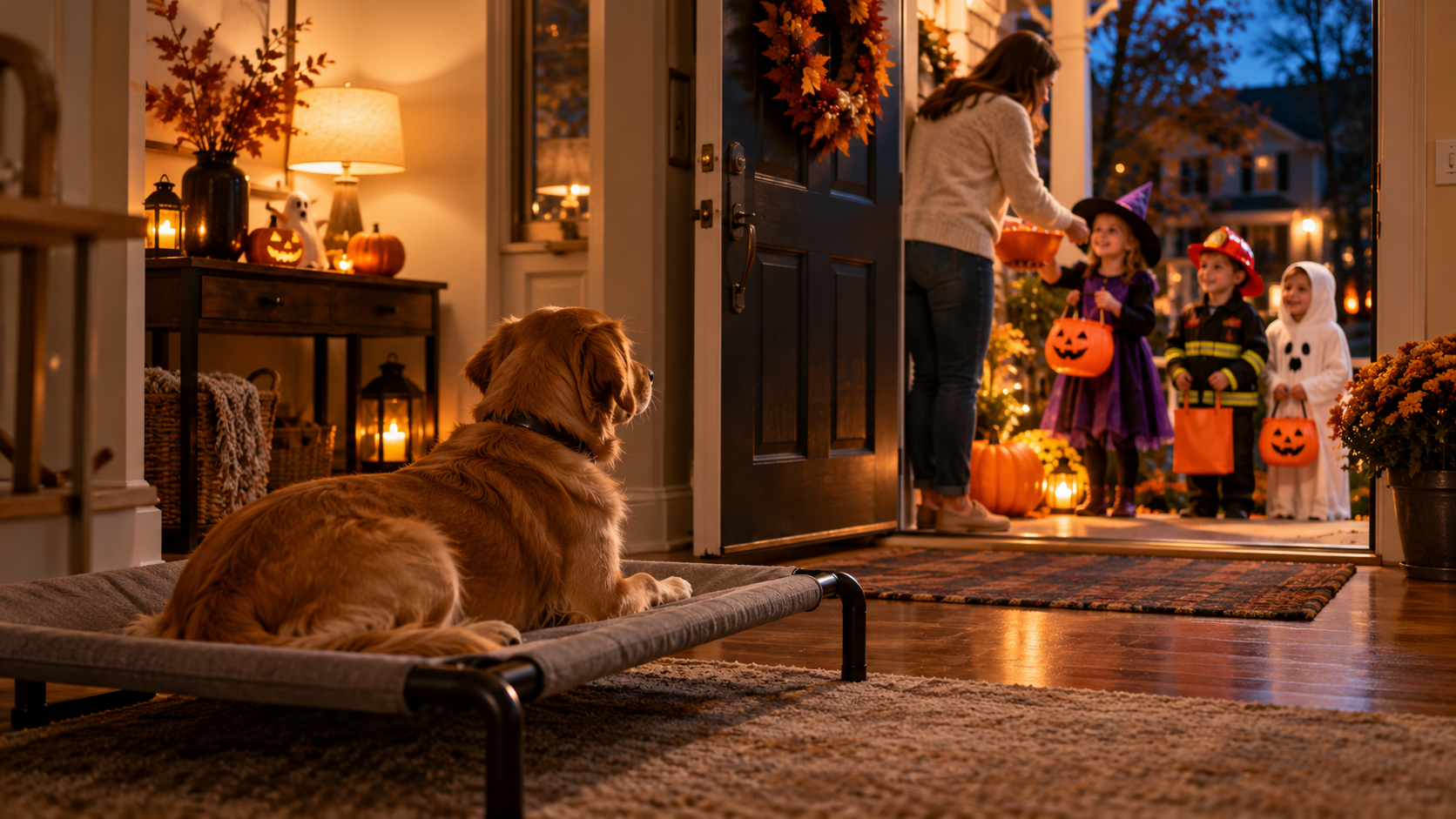
- Put the bed where it can succeed. Eight to ten feet back from the door, where he can see what's happening but isn't in the traffic lane. Out of arm's reach of the doorway. A dog who can't see the door will break position to go look; that's not disobedience, that's information.
- Use a bed with edges. A raised cot or a bolstered bed gives him a clear boundary. A flat blanket is a vague suggestion.
- Leash him to start. A light leash on the floor, or a long line, with you holding the end for the first several groups. Not to correct him, but to prevent a rehearsal you don't want and to keep him off the porch. Dogs die on Halloween running out open doors. You can drop the leash once the pattern is obvious.
- Pay well. Chicken, cheese, hot dogs, roast beef. This is not a kibble night. You're competing with the most interesting thing that's ever happened on your sidewalk, and the paycheck has to match the job.
- Wear the treats. On your body, in a pouch or a pocket, both hands free. If you have to walk to the counter, you've already lost the rep.
- Stage the candy bowl within reach of the door so you're never turning your back on your dog.
- Get a second adult if you possibly can. One of you works the dog, one works the door. It makes the whole night about three times easier.
The loop
Here's the sequence. Same every time.
- Hear them coming. Footsteps on the walk, voices, a flashlight bobbing. This is your cue, not the doorbell.
- Send him to the bed. One cue, in your normal voice.
- Pay him on the bed, immediately. Walk the treat to his mouth. Do not call him over to get it.
- Answer the door and hand out candy.
- Pay him again, while the door is open. This is the rep that matters most.
- Close the door. Release him with your release word, and let him get up.
- Reset. Next group is probably ninety seconds out.
Repeat. Forty times.
The four details that decide whether this works
Beat the doorbell for the first ten groups
This is the big one, and it's the step everybody skips. If you wait for the bell, your dog hits full arousal before you've said a word, and now you're trying to train a dog who's already gone. Send him to the bed when you hear them on the walk. You want him lying down and chewing before the button ever gets pushed. After ten or fifteen clean reps like that, start letting the bell do the work. By then it's a cue instead of a trigger.
Never pay a barking dog
If he's barking when the food arrives, you just paid for barking. He doesn't know you meant the bed. Wait for a breath of quiet, even half a second, and pay that. But better: if he's barking, you started too late. Back up and catch the next group earlier. The fix is almost always timing, not correction.
Pay him where he is
Every treat gets delivered to his mouth on the bed. The second you call him to you for the food, you've taught him that the way to get paid is to leave the bed, and you'll spend the rest of the night wondering why he keeps popping up.
Use a release word, every single time
“Free,” “break,” “okay,” pick one and use it. Place without a release isn't a behavior, it's just a dog waiting to see if he can get away with leaving. The release is what makes staying meaningful, and it's what you'll use for the rest of his life.
What the night should look like
Groups 1 through 5: clumsy. You're luring, he's popping up, you're repeating yourself. Normal. Don't panic and don't escalate.
Groups 5 through 15: he starts going when you ask, then starts anticipating. You'll notice you're saying the cue later and later because he's already moving.
Somewhere around 20: the doorbell rings and he turns toward the bed before you open your mouth. That's the moment. That's the thing you came for.
After 30: he beats you to it, lies down, and stares at you like you owe him money. You do. Pay him.
Quit before you have to. When the little kids stop coming and the teenagers start, maybe 8:30, put him away for the night with something to chew. Ending while he's still winning is worth more than squeezing out another ten reps with a fried dog. And if at any point he stops taking food, starts panting hard, or can't settle between groups, you're done for the night regardless of the clock. That's not stubbornness, that's a full tank.
Sunday morning, don't let it evaporate
You just built something real in three hours. It will fade in two weeks if you don't touch it.
Three reps a day, that's all. Have someone ring the bell, or ring it yourself on your way in from the car. Send him, pay him, release him. Thirty seconds.
Because here's what's coming: Thanksgiving. Twelve people, a door that opens eight times, food on the counter, and nowhere good to put the dog. Halloween is the dress rehearsal. You've got four weeks.
Two safety notes, because it's still Halloween
Costumes break every rule your dog uses to recognize people. Shape, face, voice, the way someone walks. A dog who adores children has never met a four-foot stranger in a mask holding a plastic sword. Don't test it. He works from the bed, the kids stay on the porch, and nobody pets the dog tonight.
Guard the threshold. Your dog should never be between you and an open door. If he's loose and the leash is off, the second adult has him.
Not sure whether Saturday is a training night or a back-bedroom night for your dog?
That's a two-minute conversation, and I'd rather have it before Halloween than clean up after it. I do a free 15-minute call. Tell me what your dog does when the doorbell rings and I'll tell you straight which one you've got. Schedule a call, and if the door is your dog's weak spot year-round, our 1-on-1 training program builds this exact skill in your home, on your actual doorbell.
Bart Merrell, Top Dog Dog Training, serving Salt Lake, Utah, Summit, and Weber counties.
Frequently asked questions
Keep reading
Written by Bart Merrell, certified dog trainer at Top Dog Dog Training.