Puppy Biting: Why It Happens and When It Stops
By Bart Merrell ·
Why puppies bite, when the sharp-teeth phase ends, and exactly what to do about it today so it never becomes a habit. Practical tips from a Utah dog trainer.
If you're reading this while covered in tiny puncture wounds, you're in good company. Puppy biting is the single most common frustration new puppy owners bring to us. The good news is that it's a phase. The better news is that how you handle the phase decides whether it stays a phase or turns into a habit.
Let me walk you through why it happens, when it lets up, and exactly what to do about it today.
Why puppies bite
There are three overlapping reasons, and all of them are normal. Your puppy is teething and their mouth hurts. Your puppy explores the entire world with their mouth, the same way a baby grabs everything in reach. And your puppy plays with other dogs using their teeth, so they try that same game on you.
Notice what's not on that list: aggression. Normal puppy biting is not your puppy being mean or dominant. It's a baby animal doing exactly what baby animals do. That matters, because it means the answer is teaching, not punishing.
The real goal is bite inhibition
Here's the thing most people miss, and it changes everything below. You are not trying to build a puppy who never puts teeth on anything. You are trying to build a puppy who learns to control how hard that mouth closes. Trainers call it bite inhibition, and it's one of the most important things a young dog ever learns.
A puppy who learns "teeth on skin ends the fun" develops a soft, careful mouth. That soft mouth is a safety feature your dog carries for life, long after the sharp baby teeth are gone. So every tip below is really aimed at the same lesson: gentle gets you the game, too hard ends it.
When does it stop?
Most puppies grow out of the worst of the mouthing between four and six months, once the adult teeth are all the way in. But "grows out of it" quietly assumes you're teaching an alternative the whole time. A puppy who bites hands unchecked at twelve weeks becomes an adult dog who bites hands. The habit doesn't magically vanish with the baby teeth. What you're doing right now is what decides how the adult dog turns out.
What to do right now
Here's your daily playbook, and the reason behind each piece.
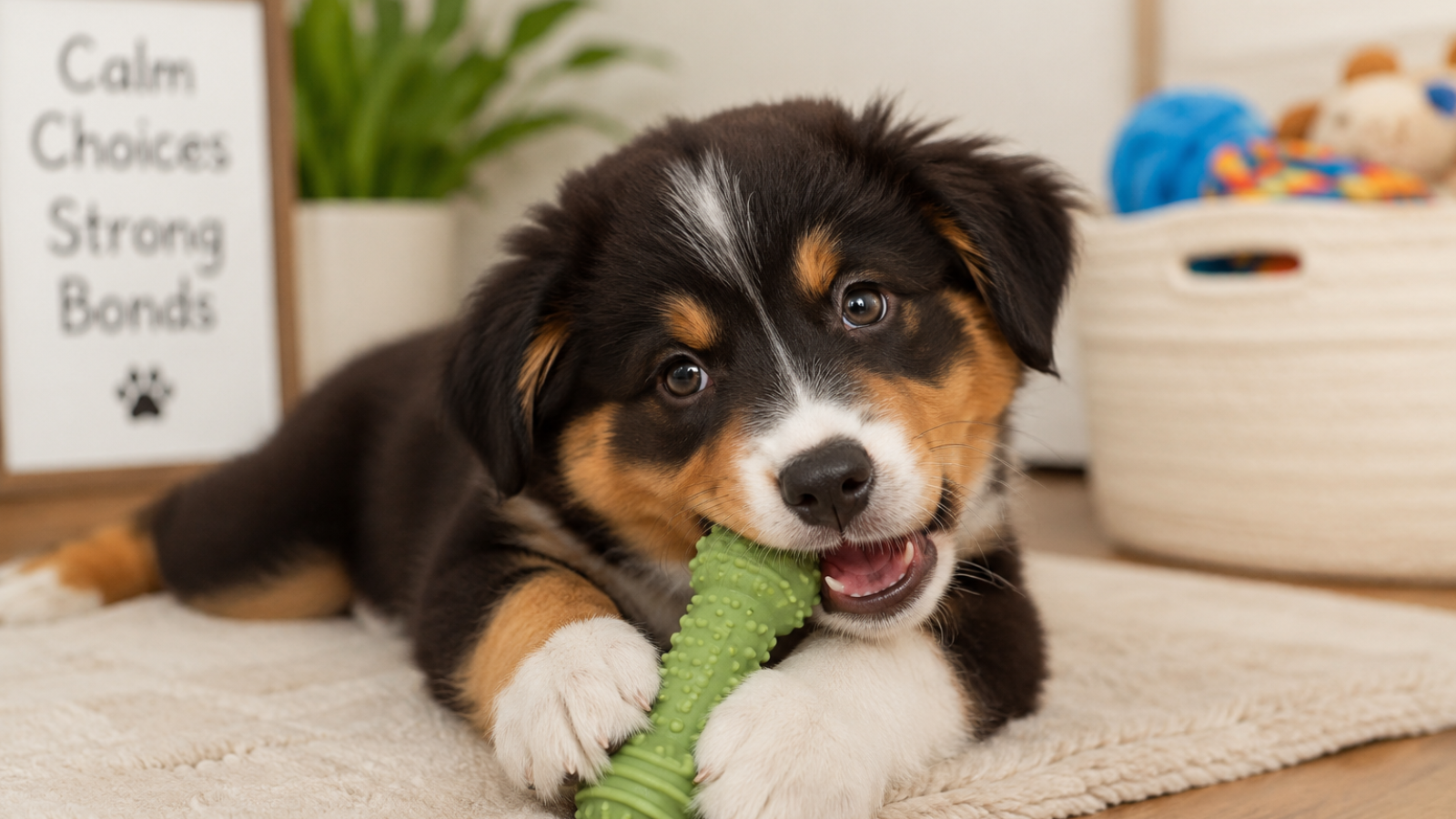
- Keep an appropriate chew in every room. When the teeth come out, redirect straight to the chew. You're not just stopping the biting, you're showing the puppy what their mouth is for.
- Reward calm chewing. Yes, actually reward it, with quiet praise, a treat, or calm attention. Most people only react to the bad and ignore the good. Catch your puppy chewing the right thing and you'll get more of it.
- End play the second teeth touch skin. Stand up, no drama, walk away, and come back in thirty seconds. This is the core bite-inhibition lesson in action: teeth on skin makes the fun person disappear. Puppies learn this fast when you're consistent.
- Teach "trade." Swap a toy for whatever is in their mouth so your puppy learns to happily give things up. This heads off resource guarding down the road and makes "drop it" easy later.
- Enforce naps. This is the one nobody believes until they try it. A tired puppy bites, and an overtired puppy bites like a little land shark. Young puppies need a shocking amount of sleep, and a lot of "my puppy is suddenly a maniac" is really just a puppy who missed a nap. When the biting spikes out of nowhere, try quiet crate time before you try anything else.
Get the whole house on the same page
Here's the number one reason puppy biting training fails: everybody's playing by different rules. If you calmly redirect every nip but the kids let the puppy gnaw on their sleeves because it's cute, your puppy learns the rules are negotiable, and negotiable rules aren't rules. Everybody who touches the puppy needs to run the same playbook. Same response, every time. Consistency is what turns a lesson into a habit.
Puppies and kids
Kids and puppies are a special case, because to a puppy a running, squealing kid looks exactly like a moving squeaky toy. That's not the kid's fault or the puppy's, it's just physics. Teach your kids that when the puppy gets nippy, the move is to stand up, cross their arms, and be boring, not to run and shriek, which only cranks the puppy up. And always supervise. A lot of the time you're managing the setup, not correcting the puppy.
What not to do
Please skip these. Don't wrestle your puppy with your bare hands. Don't jam a finger down the throat "to teach them a lesson." Don't clamp the mouth shut. Every one of these turns your hands into wrestling toys, which is the exact opposite of what you want, and some of them can scare a puppy into a worse problem than you started with. Calm and consistent beats forceful every single time here.
Puppy school helps
One of the fastest ways to teach bite inhibition isn't something we humans can fully do ourselves. It's other puppies. When a puppy bites a littermate too hard, that playmate yelps and quits the game, and the lesson lands in a way our two hands just can't match. Structured socialization with other puppies teaches "how hard is too hard" beautifully, and that's a big part of what our puppy school is built to do. If board & train is on your radar for later, here's how to prepare your puppy for board & train.
When to get help
If you're consistent for a couple of weeks and things aren't improving, if you're just plain overwhelmed, or if what you're seeing looks less like loose, wiggly puppy play and more like the real-aggression signs (a stiff body, a hard stare, guarding food or toys), it's worth talking to a professional. That's not failing. That's being a good owner. A free evaluation will tell you quickly whether you've got a normal puppy on your hands or something that needs a closer look.
"You're not building a puppy that never uses its mouth. You're building one that knows exactly how gently to."
Puppy driving you crazy?
You don't have to white-knuckle this phase alone. Book a free evaluation and we'll give you a real, personalized plan to get through it. Call us at (801) 592-1524. We serve Salt Lake, Utah, Summit, and Weber counties.
Frequently asked questions
Keep reading
Written by Bart Merrell, certified dog trainer at Top Dog Dog Training.