
E-Collar Training Explained (Without the Myths)
By Jeff Belnap ·
What a modern e-collar actually feels like, how we introduce it, and why it's the fairest tool we have for off-leash freedom.
The e-collar is the most misunderstood tool in dog training. The picture in most people's heads is thirty years out of date, built on an old name and a handful of bad videos. I don't blame anyone for it. Before I got serious about training, I had the same picture.
What changed my mind was my own dog. When she started showing aggression, I read everything I could get my hands on, sat through seminars on body language and behavior, and learned from trainers who use this tool the right way. What I found was the opposite of what I expected. Used fairly, a modern e-collar isn't harsh at all. It's one of the gentlest, clearest ways to talk to a dog at a distance. So let me clear the air. Here's what a modern e-collar actually is, what it feels like, how we introduce it, and the myths that need to go.
First, the big one: it's not a shock collar
A quality modern e-collar has nothing to do with the crude tools that gave this whole category a bad name. It uses the same TENS-style muscle stimulation your physical therapist uses on a sore shoulder. A good unit has more than a hundred levels, and most of them are so low a person can barely feel them.
We don't guess where to set it. We find your dog's working level, which is the lowest level they can just barely perceive. Usually that shows up as a small flick of an ear or a little tilt of the head, nothing more. That's the level we train on. Not the level that gets a reaction out of fear. The level that says, quietly, "hey, I'm talking to you."
What does an e-collar actually feel like?
Here's the part that settles most people down. We feel it on ourselves first. Before we ever put a collar on your dog, we run it up the levels on our own hand or neck so we know exactly what we're asking the dog to feel. I won't ask a dog to feel something I haven't felt myself.
At a working level, it feels like the tingle of your foot waking up, or a tap on the shoulder from someone trying to get your attention. It isn't pain. It's information. And most quality collars also have tone and vibration modes, so plenty of dogs end up working mostly off a buzz or a beep with the stimulation sitting far in the background.
The myths, straight up
Since the title promised no myths, let me knock down the ones I hear most.
"It hurts the dog." At the working level we use, it doesn't. A dog in pain shows you pain, and that is the opposite of what we're after. If a dog looks worried, the level is too high or the foundation isn't there yet, and we stop and fix that.
"It's the lazy way, a shortcut." Not even close. By the time an e-collar comes out, we've already spent weeks teaching the behavior on a leash. The collar doesn't teach anything new. It just gives us a way to communicate that same lesson when the leash is gone. If anything, doing it right is more work, not less.
"It'll make my dog fearful or aggressive." This is where the bad reputation comes from, and I want to be honest about it. A collar cranked too high, used with lousy timing, on a dog who doesn't understand what's being asked, absolutely can create fear. But that's an argument about skill, not about the tool. Introduced at a low level, paired with things the dog already knows, an e-collar builds confidence, because the dog finally understands the rules no matter how far away you are.
"My dog will need it forever." No. The collar fades into the background. It becomes a quiet line of communication you rarely have to use, not a crutch the dog can't live without. Plenty of our graduates wear it and almost never feel it, because the dog already knows the conversation.
How we introduce it
We go slow and we go in order.
- Step 1: Condition the low-level tap so it simply means "come toward the pressure." The dog learns that a gentle behavior turns the sensation off. They're in control of it, which is the whole point.
- Step 2: Pair that tap with commands the dog already knows on leash. Nothing new, nothing surprising. Just adding a second, quieter way to say something the dog already understands.
- Step 3: Fade the leash. Now the dog has an invisible line of communication that reaches as far as you can see, whether you're standing next to them or across a field.
Notice that we never use the collar to teach a brand new skill. Teaching comes first, always. The tool just follows.
Why we use it
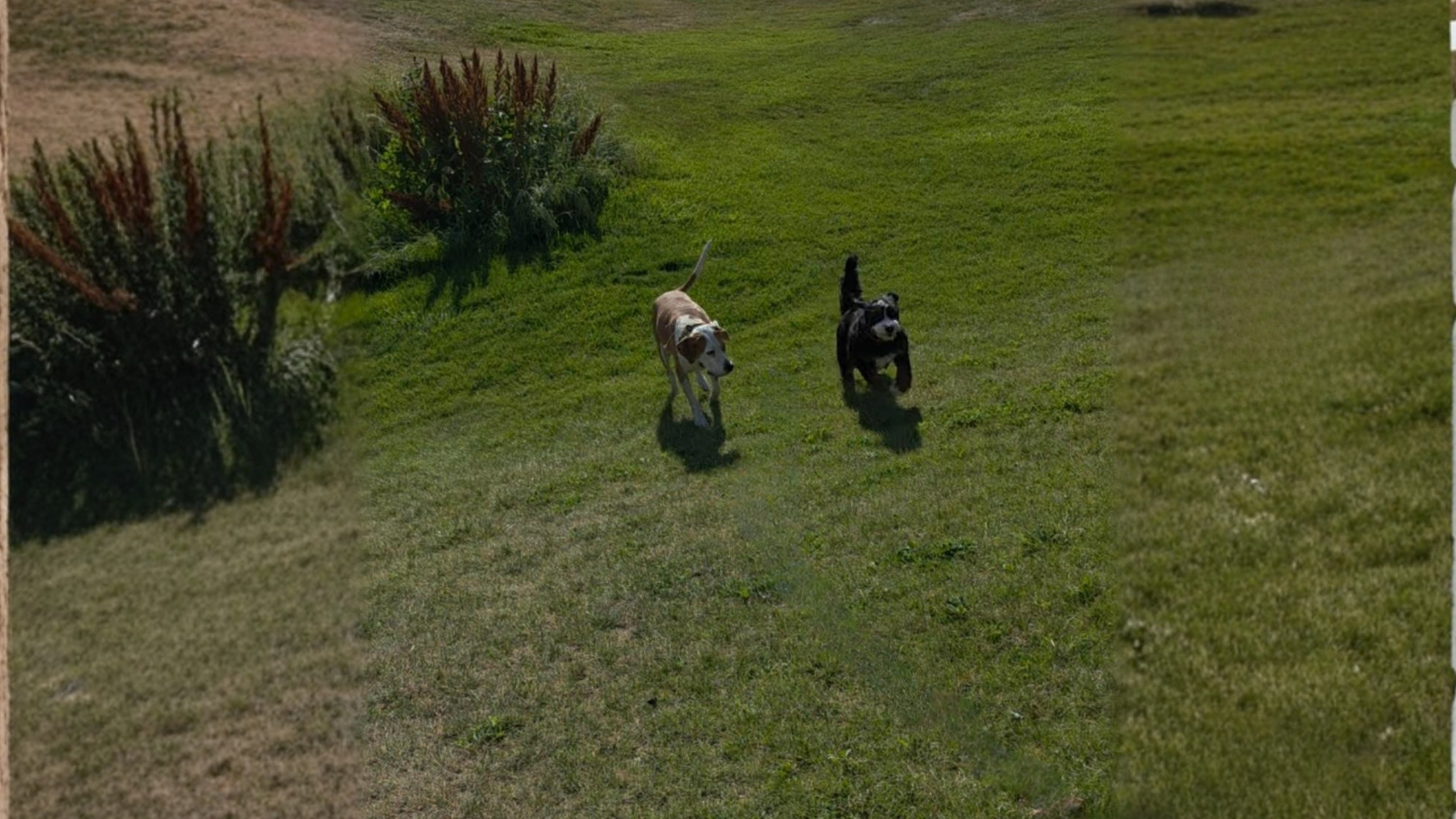
The e-collar is what lets your dog live an off-leash life. It's the difference between "stay in the fenced yard forever" and "come hike Millcreek with me every weekend." It's a reliable recall when a squirrel bolts across the trail, a rock-solid "leave it" near a busy road, and the freedom to let your dog just be a dog in the open, knowing you can reach them if you need to. This is exactly the freedom our board & train program is built around, and it's the balanced approach in action.
Freedom for the dog. Peace of mind for you. That trade is why we bother with all the careful conditioning in the first place.
When we don't use it
Just as important is knowing when to leave it in the drawer. We don't reach for the e-collar with puppies under six months. We don't use it on a fearful dog who's still learning to trust us. And we won't use it on any dog whose real problem is a missing foundation, because you can't correct a behavior the dog was never taught in the first place.
Tools follow teaching, always. Anyone who leads with the tool has it backwards.
Who's holding the remote matters most
If there's one thing I want you to take from this, it's that the e-collar is only ever as fair as the hands and the timing behind it. The same tool that gives a dog the whole outdoors can be misused by someone in a hurry. That's exactly why we condition it so carefully, and why we don't hand it off to you until we've shown you how to use it right. The goal was never to control your dog. It was to communicate with them.
"The e-collar isn't a shortcut. It's a whisper the dog can hear from a mile away."
Frequently asked questions
Keep reading



Written by Jeff Belnap, certified dog trainer at Top Dog Dog Training.